
Brand Strategy Consulting
Brand positioning, brand architecture, and portfolio decisions made deliberately — the strategic choices that determine whether creative execution compounds or dissipates.
EquiBrand is a brand strategy consulting firm that works with leadership teams to define how their brand competes, what it stands for, and how it organizes offerings to support long term growth. As an experienced brand strategy consultant, we bring an unbiased perspective to challenges internal teams are often too close to see.
Whether you are navigating crowded markets or repositioning after change, a strong brand strategy is the foundation everything else builds on. Our brand strategy work connects brand equity, brand positioning, and business strategy so efforts compound rather than compete, building market presence that endures.
What Brand Strategy Consulting Is
Brand strategy consulting covers a range of work, and that range causes most market confusion.
Creative execution, management consultancy, and business strategy
Creative agencies produce brand identity, campaigns, and content. A management consultancy works on operating model, cost, and organizational design. Brand strategy consulting sits between them, producing decisions that make creative execution coherent and tying market perception to business strategy.
What a Brand Strategy Consultant Does
A brand strategy consultant helps organizations decide how they compete: brand positioning grounded in customer research, a brand architecture that clarifies the portfolio, and the reasons-to-believe behind credible differentiation.
Strategic thinking before tactics
Messaging and tactics change; brand positioning should endure. Internal teams carry assumptions about the category and the competition, and much of the value in brand strategy consulting comes from testing those against evidence, not restating them.
What Is a Brand?
The face you put on business strategy
At the corporate level, the brand expresses vision and mission to customers, employees, and investors — the relationship a company has with its customers.
A brand is more than a product
A brand is the set of associations people attribute to a product, service, or company, with brand equity providing added value. Products deliver functional benefits and can be objectively measured; brands deliver functional and emotional benefits, live in customers’ minds, and resist objective evaluation.
What a brand is not
A brand is not a name, logo, or tagline — those are tangible things that represent it. Confusing the representation with the asset is the most expensive error in brand management.
Brand image, brand identity, and negative equity
Brand identity is what the organization intends; brand image is what the market perceives. The gap is where brand strategy begins. Brands can also carry negative equity — in blind versus branded testing, a poor image measurably reduces what customers pay for an identical product.
Why Brand Building Supports Long Term Growth
Brands shift the demand curve
A strong brand generates superior profits by maximizing volume and price potential, routinely overcoming a gap in blind product preference.
Competitive differentiation and price premium
Differentiation supports premium pricing beyond commoditization — the most direct expression of brand strength and the clearest of the measurable business outcomes brand investment produces.
Credibility, customer loyalty, and internal focus
An established brand lends credibility to new introductions. For customers, brands simplify decisions, assure quality, and reduce risk — shortening sales cycles and building customer loyalty. Internally, it guides resource allocation and drives employee engagement.
Brand Migration: From Current Image to Brand Vision
Brands already exist in customers’ minds. Usually the work is migrating one rather than creating it — strengthening it as market shifts and competitive intelligence warrant.
Current image, brand vision, and the gap between
Point 1 is the current brand image, from a brand audit and market research — how customers view the brand against competitors. Point 2 is the brand vision: what the brand aspires to be, and whether it needs new associations. Point 3 is the gap, and closing it is the role of brand strategy.
The Four Keys to Brand Management
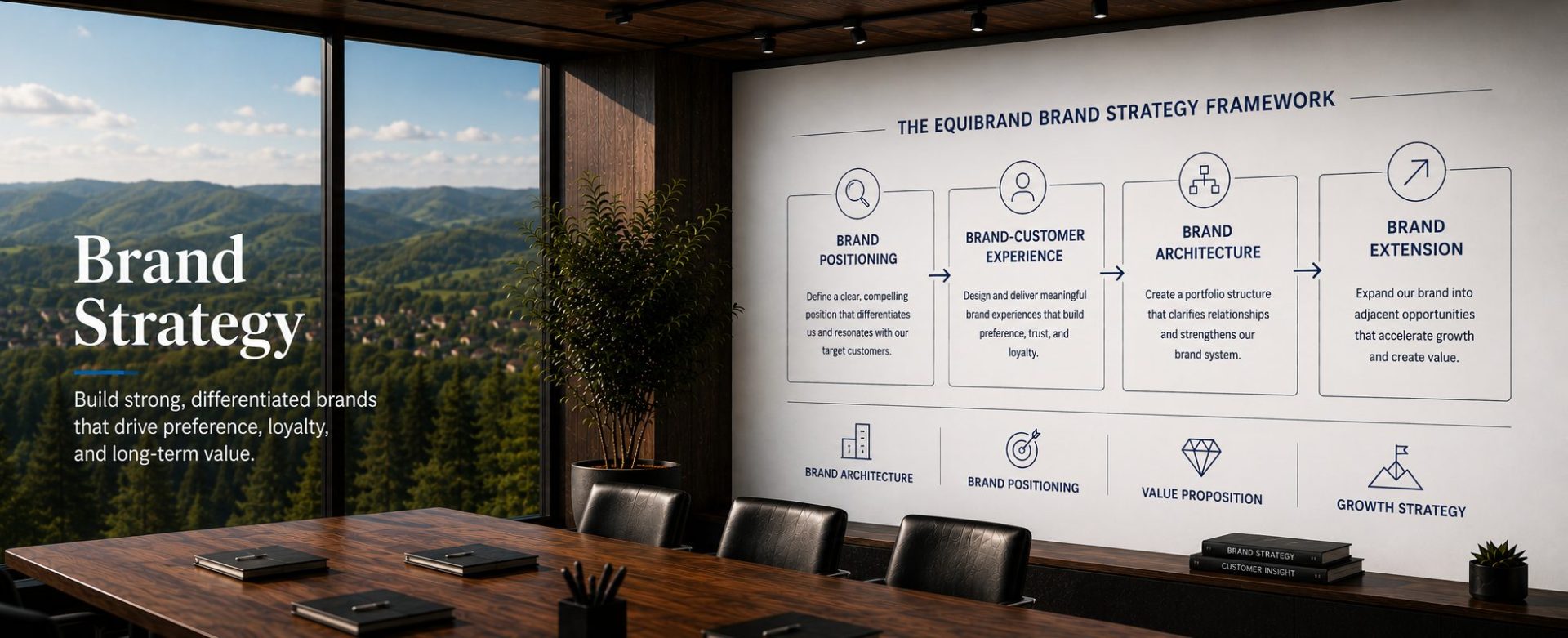
Our brand strategy framework organizes brand strategy consulting into four connected components.
1. Brand positioning
The conceptual place you want to own in the target customer’s mind — the benefits you want them to think of when they consider your brand.
2. Brand-customer experience
The totality of how customers interact with your business and brand across the touchpoints they encounter on their journey.
3. Brand architecture
The logical, strategic, and relational structure of all products and brands in the portfolio.
4. Brand extension
Stretching established brand names into new products or new categories where the equity travels.
Brand Positioning
At the core of the most valuable brands is a clear expression of positioning, supported by aligned messages and touchpoints.
Brand positioning strategic choices
Positioning is the art of sacrifice, across four elements.
Definition of target markets
Who is the brand built for — the bullseye center? Defined tightly enough to exclude someone.
Category frame of reference
What is the competitive context, and what should the category be called? The comparison set drives expectations.
Key benefits delivered
What should the brand stand for and deliver on? Position on a single idea, even with two benefits.
Reasons-to-believe
What proof points make the positioning credible? Without them a point of difference is an assertion, and buyers discount assertions.
The positioning template
To [target audience], Brand X is the only [category or frame of reference] that gives you [points of differentiation / benefits delivered] because [reasons to believe].
The format’s value is its intolerance for vagueness. A leadership team that cannot complete it has found its real problem.
Relevance, differentiation, and sustainability
Relevant but undifferentiated brands risk commoditization; differentiated but irrelevant brands become niche providers. An impactful brand strategy rests on competitive positioning that is relevant, distinctive, and credible.
Four ways to position a brand
- Own the category benefit — effective where the brand leads or perceptual white space exists
- Position how the company does business — operating practices strung into a customer benefit, aligned to core values
- Position the product and the consumer — higher on the benefit hierarchy, emotional and self-expressive
- Position against the competition — referencing rivals indirectly through distinctive practice
Core Values, Verbal Branding, and Visual Identity
A tagline is an outgrowth of positioning, not the positioning itself. Verbal branding covers associations, brand story, core values, and the keywords used to be found online; visual identity covers logo, imagery, and materials. Together they express the brand promise.
Creative direction and the brand development brief
A brand development brief articulates positioning, benefits, and brand story — the blueprint directing creative strategy, creative direction, and implementation partners.
Brand-Customer Experience
Positioning focuses on what is delivered. How it is communicated, and delivered operationally, matters equally.
Customer journey mapping
A journey map documents what customers are thinking, doing, and feeling at each stage, against the touchpoints they encounter.
From the “as is” journey to the ideal experience
Document the journey by which customers become aware of and experience the brand — journeys are nonlinear. Then identify friction points and design them out, pushing beyond fast-and-easy toward the quality cues customers value.
Step 3: Align brand touchpoints
Integrate touchpoints across channels, media, and messaging. Ask where an eighty percent improvement comes from a twenty percent investment. Conversion metrics isolate leverage points — how many aware customers purchase, and how many stay.
Brand Architecture
Customers relate to brands at different levels — corporate brand, product brands, product descriptors.
Clarity, synergy, and leverage
Clarity: is it evident how everything fits together? Synergy: does the structure deliver a larger promise than any single brand? Leverage: can brands extend to capture new segments?
Four primary brand architecture models
Branded house
A single master brand with descriptors. Leverages established equity with minimal investment behind new offerings, with strong economies of scale. Typically the default strategy.
Sub-brand
Sub-brands modify associations of the master brand and can stretch it into new arenas with a distinct value proposition.
Endorsed brands
The endorser provides credibility while the endorsed brand retains freedom to develop its own associations and identity.
House of brands
Stand-alone brands each focused on a market segment. Useful for dominating niches and avoiding incompatible associations.
Hybrid approaches and the branded-house trend
Optimal structure is not either/or — most companies build adaptive brand systems that mix models. Best practice invests in the fewest brands needed, elevating a master brand with generic descriptors.
Names versus brands, and empty vessels
Names are descriptors identifying tangible value; brands require investment and represent value beyond functionality. Brands not adequately managed become empty vessels with no meaning in the marketplace.
Brand architecture management steps
Obtain business strategy inputs; confirm the “as is” architecture; research brand strength, customer bandwidth, and resources; develop alternatives; confirm hierarchy and naming.
Brand Extension
Why extension creates economic leverage
Stretching an existing brand into new categories raises the chance of success while cutting cost — through awareness, accelerated trial, and distribution leverage.
When extension works, and when it fails
Successful extensions build on parent-brand equities, carrying the brand experience into the new category intact. Extensions requiring associations the parent never earned dilute the master brand and rarely establish the new one.
Start Your Growth Assessment
The most efficient start is a structured read of where brand strategy is clear and where it is not.
Our Growth Assessment evaluates target definition, category frame, competitive differentiation, and portfolio structure — identifying which unresolved decisions constrain growth.
Start Your Growth Assessment →
Brand Strategy Consulting Services
Positioning, architecture, and naming
Brand positioning defines where the brand competes and why it wins. Brand architecture establishes which brands carry equity and how new offerings enter the system. Brand naming follows architecture rather than preceding it.
Messaging, market research, and brand equity
Messaging translates position into a hierarchy that survives the market. Brand research grounds strategy in evidence rather than internal consensus, and baseline equity metrics separate demonstrating effect from asserting it.
Brand Strategy Consulting Versus Branding Agencies
What a branding agency delivers
Identity systems, campaigns, websites, content. The model rewards volume of creative output.
What a brand strategy consulting firm delivers
A position, an architecture, a hierarchy. The model rewards clarity, and the engagement ends.
Which one you need
Clear strategy with weak execution calls for an agency. Well-made work that is not compounding indicates a strategy problem, and more output will not fix it. We do not sell creative execution, so recommendations carry no implied downstream scope.
When Organizations Engage a Brand Strategy Consultant
- Growth has slowed despite strong execution — capable teams, flat results, indicating a strategic rather than effort constraint
- Competitive differentiation has eroded and the category is being decided on price
- Acquisitions have fragmented the portfolio with no governing logic
- A new category or segment is being entered and the existing position does not extend
- Leadership, sales, and marketing describe the business differently
- A capital event is approaching and portfolios that cannot be explained simply are discounted
What to Look For in a Brand Strategy Consulting Firm
Who actually does the work
Ask which individuals will staff the engagement and how they complement internal capabilities. The gap between pitch and delivery teams is the most common disappointment.
Whether they also sell creative execution
A brand strategy firm that also sells implementation has an interest in the scope of what it recommends. Ask what happens commercially if the recommendation is to change nothing.
Whether structured methodologies are explicit
The right brand strategy firm describes its framework before knowing your business. Proprietary language that cannot be explained is a warning sign.
Market research and strategic rigor
Positioning built on internal workshops alone encodes internal beliefs. Ask how customer perspective enters, and how a prior recommendation was reached — strategic rigor means conclusions traceable to evidence.
Pattern recognition and a decidable deliverable
Exposure to your structural problem matters more than sector familiarity; industry trends change but structural patterns repeat. The output should include explicit exclusions — a document that offends no one has decided nothing.
How Our Brand Strategy Consultants Work
Establish the current brand image
What the brand means in market today, as distinct from what the organization intends.
Define the strategic choices
Working sessions with the leadership team to resolve the four positioning elements, including what the brand will no longer claim.
Build architecture and message hierarchy
Translating position into portfolio structure and message hierarchy so strategy holds across offerings.
Measure brand performance and enable execution
Baselines make it possible to track brand performance and message consistency over time. We brief whoever executes — internal team, agency, or brand refresh partner — so strategy survives translation.
Representative Brand Strategy Engagements
Client identities are confidential. Situations are described because organizations recognize their problem in someone else’s.
- A national services organization had grown through acquisition into a portfolio its own sales force could no longer explain. We rebuilt the architecture around a single proposition with a stakeholder-specific hierarchy beneath it.
- An established consumer brand was losing share on a benefit it had originated but no longer claimed. Repositioning restored the point of difference and reframed the category.
- A medical technology manufacturer was preparing a costly consumer campaign for a product consumers had no role in selecting. Redirecting spend toward professional touchpoints improved brand perception among the audience that actually decided.
- A manufacturer facing commoditization reframed its category around total operating cost rather than unit price, shifting the comparison set and restoring pricing power.
Measuring Brand Equity and Brand Performance
- Unaided awareness within the defined target segment
- Association strength on the specific benefits the position claims
- Perceived differentiation against the named competitive set
- Price tolerance relative to alternatives
- Customer loyalty and retention across the portfolio
- Internal consistency across functions
Frequently Asked Questions
What is brand strategy consulting?
Brand strategy consulting decides what a brand stands for, who it is for, and how it is structured — upstream of any visual expression. Positioning, architecture, naming, and messaging are the deliverables. Design follows from them; it does not substitute for them.
What does a brand strategy consultant do?
A brand strategy consultant makes a small number of decisions explicit and defensible: the target market, the category frame, the benefits the brand will own, and the proof behind them. The work is research, analysis, and facilitation, not creative production.
What is the difference between brand consulting and brand strategy consulting?
They are used interchangeably. The distinction that matters is between strategy and creative execution — some brand consultants deliver identity systems, others positioning and architecture.
When should you hire a brand strategy consultant?
At an inflection point, not on a schedule. The triggers are consistent: growth has stalled despite strong execution, differentiation has eroded and the category is competing on price, acquisitions have fragmented the portfolio, a new category is being entered that the current position does not reach, leadership and sales describe the business differently, or a capital event is approaching. A brand that is already clearly defined and performing does not need one.
Why hire an outside consultant instead of building the capability internally?
Internal teams know the business better and see it less clearly. The constraint is rarely capability — it is that people close to a brand cannot easily assess how it is actually perceived, and rarely have the standing to settle a disagreement between functions. An external consultant brings method, comparative pattern recognition, and the independence to recommend a direction that disadvantages someone.
Is hiring a brand strategy consultant worth it?
It depends on whether a specific decision is stuck. Repositioning, a portfolio restructure, a category entry — these justify the engagement because the cost of choosing wrong is high. General brand improvement does not. The test: name the decision the engagement is meant to resolve. If you cannot, it will produce vocabulary rather than direction.
What does a brand consulting engagement actually produce?
Decisions, not vocabulary: a defined target market, a category frame of reference, the benefits the brand will own, and the proof that makes them credible. The test of any engagement is whether it changes what the organization does — including what it declines to do.
How long does a brand strategy engagement take?
A focused positioning engagement runs six to twelve weeks; brand architecture with primary research, longer.
Do we need market research, and will you handle creative execution?
Internal knowledge is valuable and systematically biased; where stakes are high, research is where the surprises are. We do not handle creative execution — clients take the work to their agency or internal team.
Talk to a Brand Strategy Consultant
Most brand problems are unmade decisions. Examining the strategy directly is the fastest way to find which ones constrain growth.
The Growth Assessment returns a clear read on where your brand strategy holds and where it does not — typically four to six weeks.
Start Your Growth Assessment →





Follow EquiBrand